Preferred in FITTER Forward
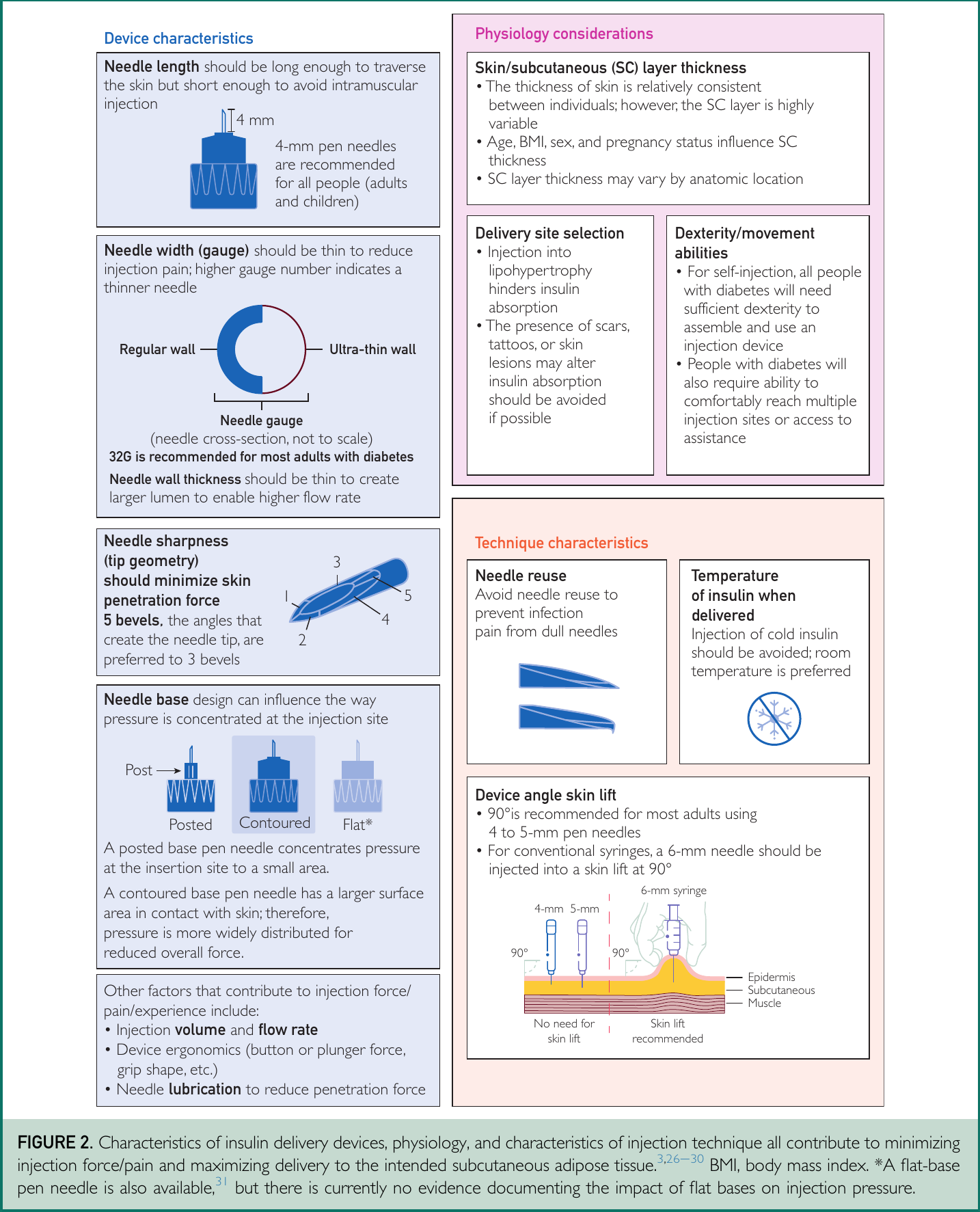
A short pen needle reaches the fat beneath the skin with less risk of reaching muscle. Most adults use a 90° angle; a skin lift may be needed when there is little fat beneath the skin.
TruCore field notes
Technique matters
The 2025 FITTER Forward recommendations, published in Mayo Clinic Proceedings, explain how devices, skin, and technique work together. Use this guide to prepare for a demonstration with your pharmacist or clinician.
A short pen needle reaches the fat beneath the skin with less risk of reaching muscle. Most adults use a 90° angle; a skin lift may be needed when there is little fat beneath the skin.
Check the millimeter length printed on the box. FITTER Forward accepts 5 mm as an alternative; it is not the same length as 4 mm. Have a clinician confirm the angle and whether you need a skin lift.
A higher gauge number means a thinner needle. Length determines depth. Confirm that the needle is compatible with your exact pen; these recommendations do not tell you how to fill an empty pen or cartridge.
The original compares skin, underlying fat, and muscle at different body sites.
A closer look at the factors behind comfortable, consistent insulin delivery. The temperature and device details shown are insulin-specific; use your own product instructions.
Use only the injection areas permitted for your medication. Rotate within and between those areas, and avoid lumps, thickened tissue, damaged skin, or irritated spots. The map below is an insulin example; its weekly schedule is not a dosing schedule for other medicines.
FITTER Forward recommends at least 1 cm between insulin injection points and a consistent rotation pattern. Ask your care team to mark the appropriate areas for your treatment.
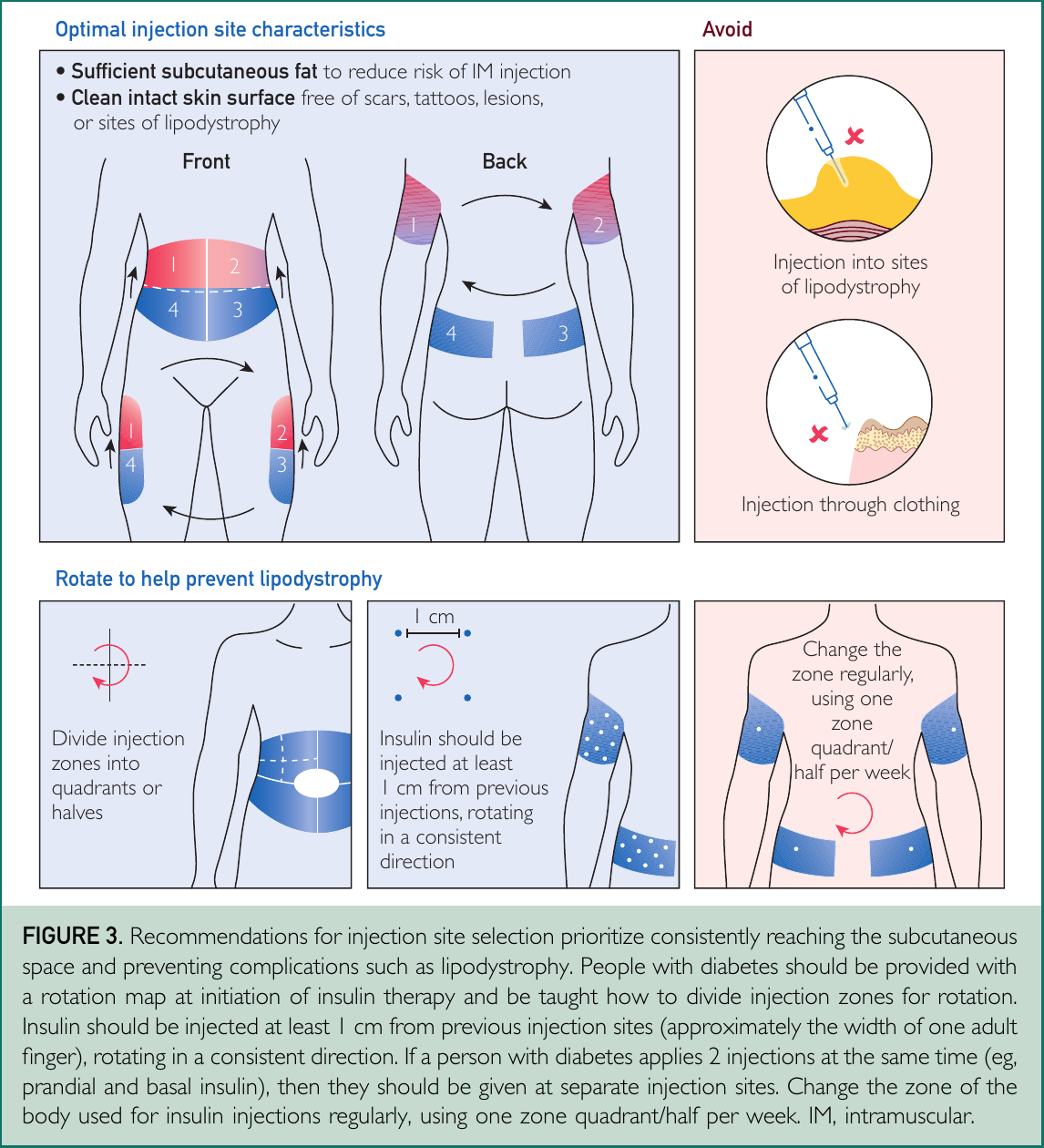
Tell your clinician about persistent lumps, unusual pain, repeated bruising, bleeding, or leakage. With insulin, moving from thickened tissue to healthy tissue can change absorption and lower glucose; arrange monitoring and dose guidance with your care team.
Check the medication, concentration, prescribed dose, expiry, and appearance against the instructions. Have a pharmacist demonstrate your exact pen and needle. Do not infer a dose from clicks or transfer instructions from a different pen.
Wash your hands and use a clean area. For pens that use detachable needles, attach a new sterile compatible needle and remove the required covers. Prime only as the device instructions direct; single-dose autoinjectors may work differently.
Use your taught injection technique and the specified hold time. Hold times and completion signals vary by product. If medication leaks or delivery seems incomplete, contact your pharmacist before repeating a dose.
Follow the device instructions for removing a detachable needle. Put used sharps immediately in an FDA-cleared sharps container. Never share a pen, even with a new needle. Store the device as labeled.
Technique: FITTER Forward, section 2 ↗ · Disposal: FDA sharps guidance ↗
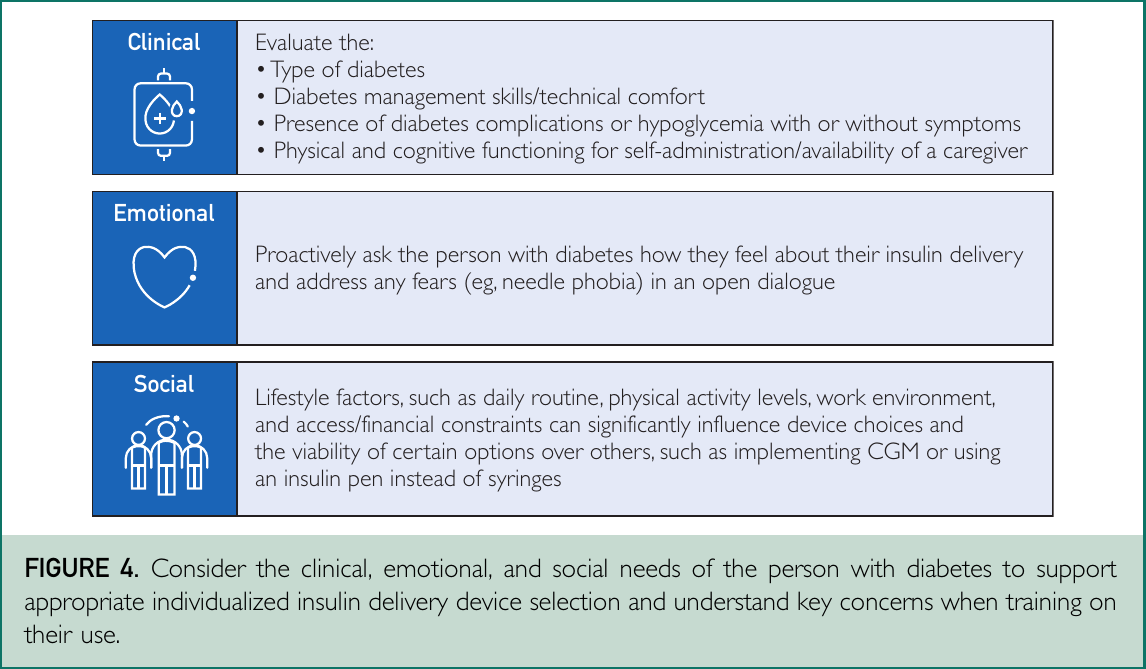
Bring your questions about grip, vision, needle anxiety, travel, or cost. A hands-on demonstration and a chance to show the technique back can reveal what needs adjusting.
Read the evidence
Klonoff DC, Berard L, Franco DR, et al. Advance Insulin Injection Technique and Education With FITTER Forward Expert Recommendations. Mayo Clin Proc. 2025;100(4):682–699. doi:10.1016/j.mayocp.2025.01.004 ↗
© 2025 The Authors. Published by Elsevier Inc on behalf of Mayo Foundation for Medical Education and Research. Article and figures 2–4 licensed under Creative Commons Attribution 4.0. TCW wrote the surrounding summaries and added its own layout; the reproduced figures retain their original content and captions. Figure 1 is linked separately because its credit specifies a noncommercial license. No endorsement of TCW is implied.
Read the full article in Mayo Clinic Proceedings ↗Field note 03
There is no universal “peptide storage rule.” The product label or dispensing pharmacy instructions outrank internet charts, general timelines and habits from a different medication.
Unreconstituted
Reconstituted or opened
Cold-chain awareness
FDA has received complaints about injectable GLP-1 products arriving warm or with inadequate refrigeration. FDA storage guidance ↗
Field note 04
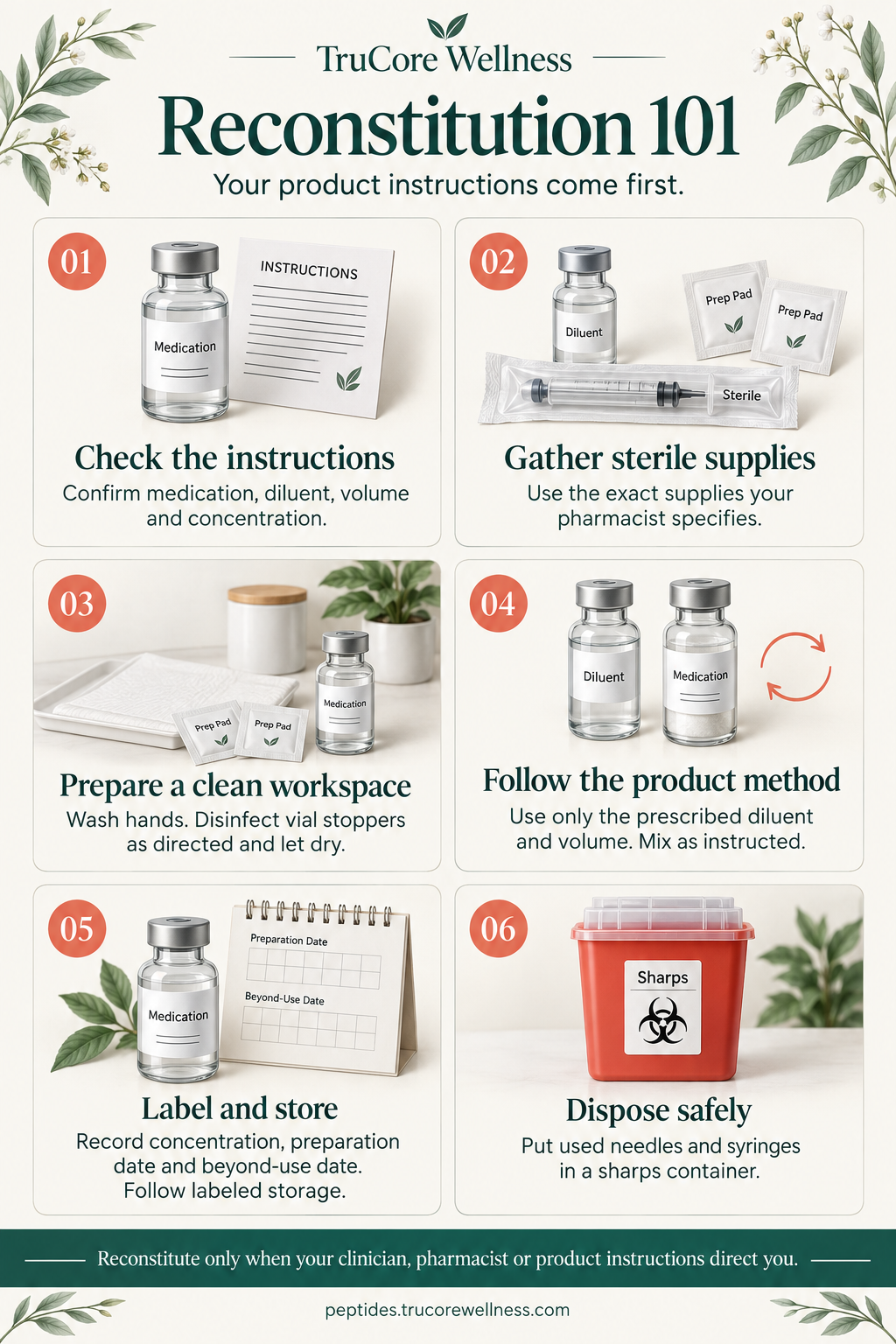
A sterile preparation step, not a kitchen recipe. Reconstitute only when a licensed clinician, pharmacist or the approved product instructions tell you exactly what diluent, volume, concentration and technique to use.
The safe baseline
Confirm the exact medication, diluent, final concentration, storage condition and beyond-use date.
A new sterile needle and syringe are required for every vial entry and every injection.
Use a clean work area, disinfect vial stoppers as directed, and never touch sterile connection points.
Record the requested date/concentration and place used sharps directly into an appropriate sharps container.
Supplies, translated
A capacity, not a dose. It may be used for transfer or reconstitution when the instructions call for that volume.
Smaller capacity with finer markings. It can support accurate measurement—but only after the concentration and prescribed volume are known.
A sterile prescription diluent containing benzyl alcohol. It is not a universal default and should be used only when the medication instructions permit it.
Use a labeled medical product as directed. Let the stopper or skin dry after preparation; do not improvise with household wipes.
Anything that touches an injectable product should be sterile, properly labeled and sourced from a licensed pharmacy, clinician or established medical supplier. General organizers can come from anywhere; sterile supplies should not be a gamble.
Delivery formats
Manufacturer-set concentration and device instructions. Use only the exact product’s instructions for use.
Prepared volume in a single device. Verify the label and do not transfer it to another container unless instructed.
More measuring decisions and more opportunity for unit/concentration errors. Confirm the prescribed volume with the pharmacist or clinician.