A clear map of peptide medicines & research

Small molecules.
Big questions.

An evidence-aware field guide to what these compounds are, what they are studied to do, and where the certainty ends.

Explore all 107 For learning—not personal medical advice.
Peptide Field Guide: Uses, Evidence and Context, illustrated with a molecular model and botanical details
Field plate 01 Uses, evidence & context

The 30-second primer

What is a peptide?

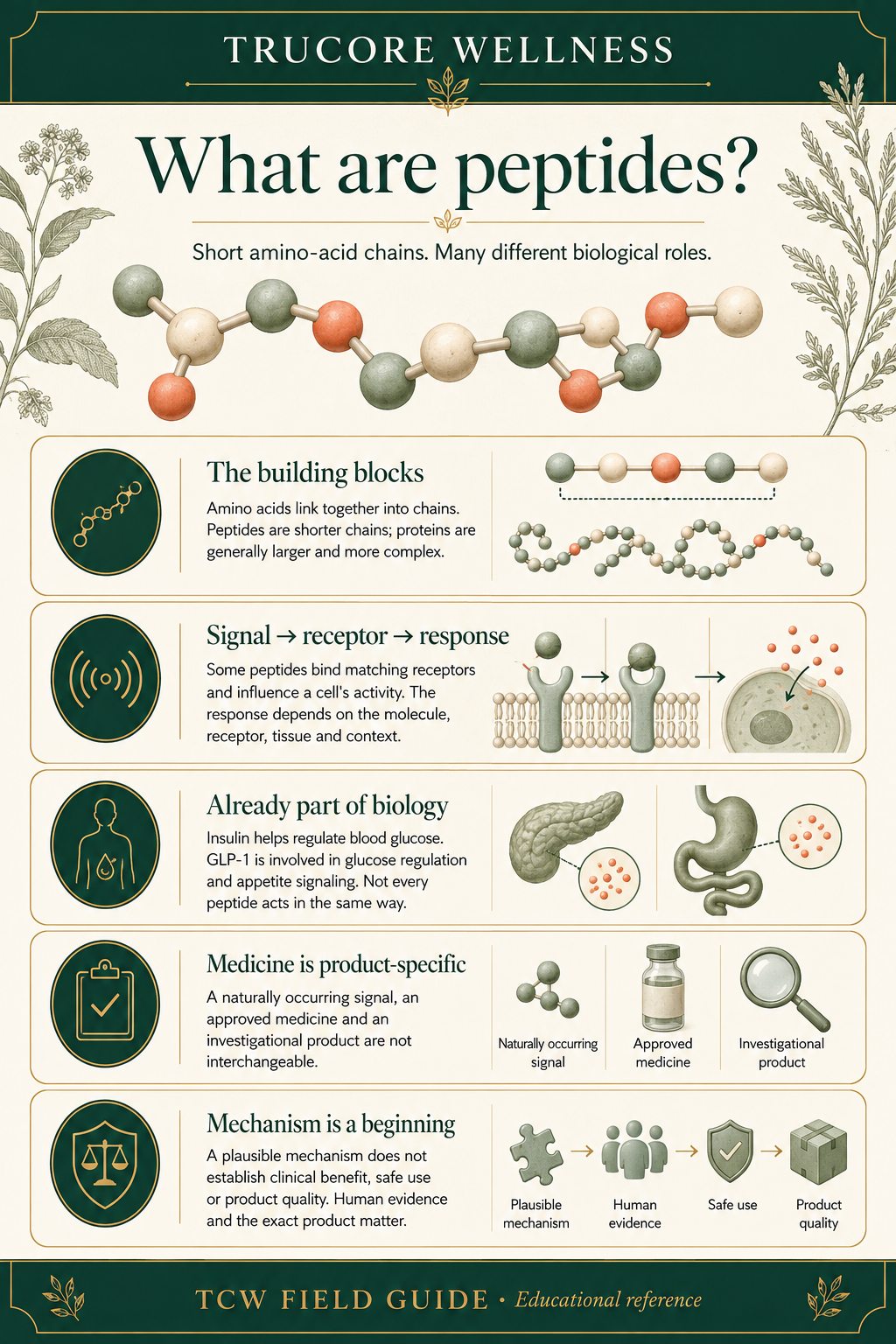
Peptides are short chains of amino acids. Many act as precise biological signals—but the catalog around them also includes hormones, blends, diluents and small molecules. This guide labels the difference.

107source-linked catalog entries
10jobs for fast filtering
11entries explicitly flagged “not a peptide”
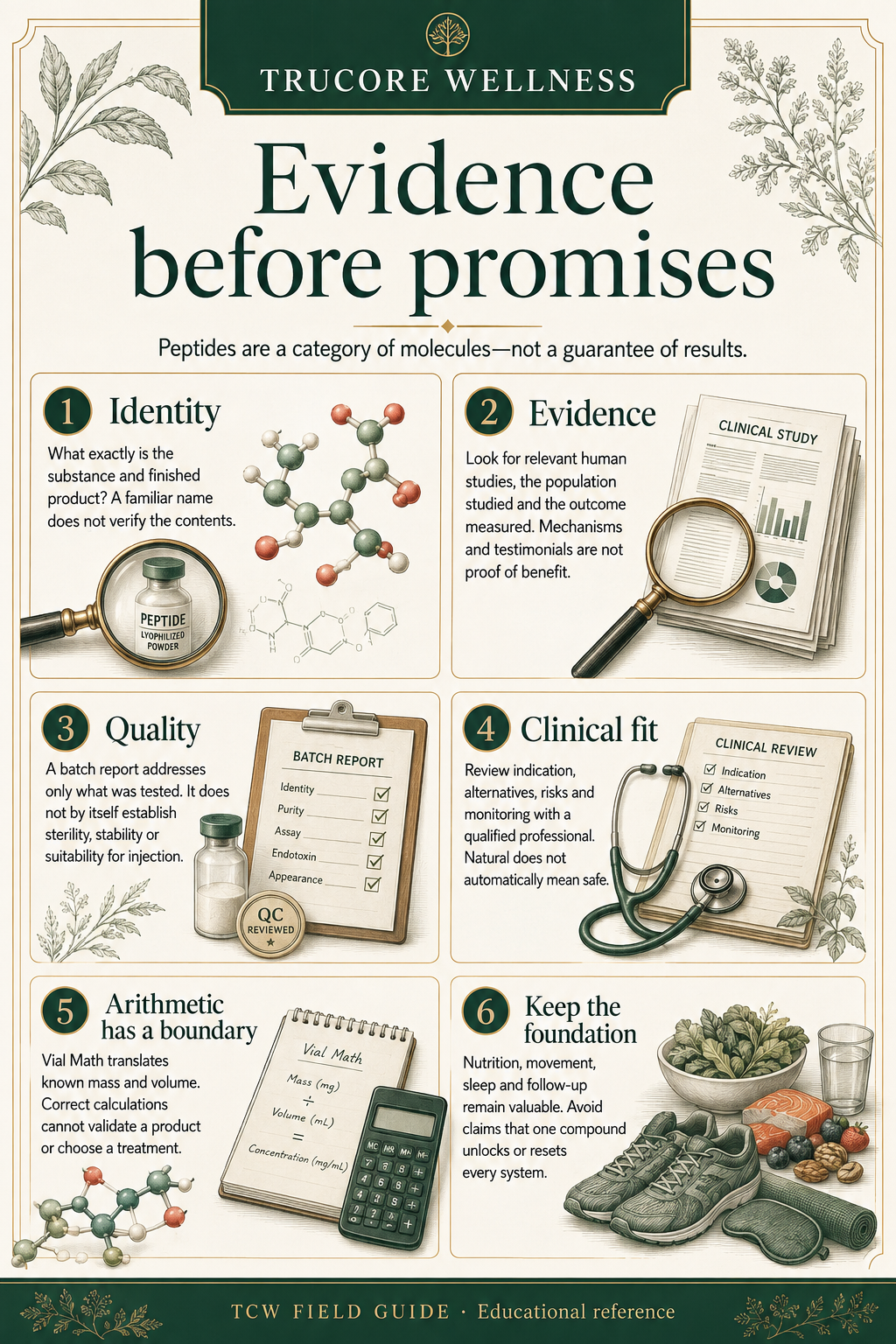
Peptide Field Guide: 107 entries, 10 jobs, one clear map, with an abstract molecular diagram
Field plate 02 The complete 107-entry landscape

Browse by job

The peptide landscape

Built from the supplied CAPeptides guide library. Every card keeps the evidence level, U.S. regulatory context, cautions and source links close at hand.

107 entries in view

001Early research

Metabolic & weight

5-AMINO-1MQ

Primary Research Goal

Inhibit NNMT signaling.

002Human evidence

Growth & body comp

ACE 031

Myostatin / Activin Signaling

Block myostatin/activin-family signaling.

003Early research

Support & other

Acetic Acid

Laboratory Function

Adjust solution pH.

004Approved active

Hormones & fertility

ACTH 1-39

Adrenal Hormone Activation

Stimulate adrenal cortisol release.

005Identity unclear

Brain & mood

Adamax

Identity First

Intended effects cannot be stated until the exact ingredients or sequence are confirmed.

006Early research

Metabolic & weight

Adipotide/FTTP

Cardiovascular Signaling

Target blood vessels supplying white fat tissue.

007Early research

Skin & cosmetic

AHK-CU

Hair-Follicle Support

Support hair-follicle signaling.

008Human evidence

Metabolic & weight

Aicar

Increased Endurance and Stamina

AICAR activates AMP-activated protein kinase (AMPK), a key enzyme involved in energy metabolism.

009Human evidence

Metabolic & weight

AOD-9604

Targeted Fat Loss

AOD-9604 has the unique ability to promote the selective breakdown of stubborn fat deposits, particularly in problem areas like the abdomen, hips, and thighs.

010Human evidence

Repair & recovery

ARA290 (Cibinetide)

Recovery and Tissue Repair

Activate tissue-protective signaling.

011Early research

Repair & recovery

B7-33

Primary Research Goal

Activate relaxin-related RXFP1 signaling.

012Approved active

Support & other

Bacteriostatic Water

Laboratory Function

Reconstitute compatible lyophilized laboratory material.

013Approved active

Skin & cosmetic

Botlioum toxin

Muscle and Lean Mass

Temporarily reduce muscle contraction.

014Early research

Repair & recovery

BPC-157

Enhanced Tissue Healing

BPC-157 peptide accelerates the healing process by stimulating the production of growth factors and promoting angiogenesis (the formation of new blood vessels).

015Early research

Repair & recovery

BPC-157 + TB-500

Enhanced Tissue Healing

BPC-157 peptide accelerates the healing process by stimulating the production of growth factors and promoting angiogenesis (the formation of new blood vessels).

016Early research

Immune & inflammation

bronchogen

Recovery and Tissue Repair

Support respiratory-tissue repair claims.

017Human evidence

Metabolic & weight

Cagriema(10ng- 10mg)

Hunger Suppression

Suppress hunger and increase fullness.

018Human evidence

Metabolic & weight

Cagrilintide

Hunger Suppression

Suppress hunger and increase satiety.

Signal stack

GLP-1, GIP & glucagon

These names describe receptors—not interchangeable products. A medicine can activate one pathway, two, or all three, and that changes both the research question and the safety picture.

01

GLP-1

Supports glucose-dependent insulin release, slows gastric emptying and increases satiety.

02

GIP

An incretin signal involved in glucose-dependent insulin release and nutrient handling.

03

Glucagon

Raises liver glucose output; in multi-agonist research it is also explored for energy expenditure.

CompoundGLP-1GIPGlucagonContext
SemaglutideGLP-1
Approved active · product-specific

One incretin pathway: appetite, satiety and glucose-dependent insulin signaling.

TirzepatideGIP + GLP-1
Approved active · product-specific

A dual agonist combining two incretin signals.

RetatrutideGLP-1 + GIP + glucagon
Investigational · not FDA approved

A triple agonist still being evaluated in phase 3 research.

Survodutide / MazdutideGLP-1 + glucagon
Investigational in the U.S.

Dual-pathway programs pairing appetite signaling with glucagon activity.

Regulatory checkpoint: FDA states that retatrutide is not an FDA-approved drug and cannot be used in compounding under federal law. Read the FDA notice ↗

Field note 03

Storage & handling

There is no universal “peptide storage rule.” The product label or dispensing pharmacy instructions outrank internet charts, general timelines and habits from a different medication.

01

Unreconstituted

Dry powder / lyophilized

  • Keep it in the original labeled container.
  • Protect it from heat, light and moisture.
  • Refrigerate only when the product-specific instructions require it.
  • Research vials may have no validated stability data at all.
02

Reconstituted or opened

Solution in the vial

  • Follow the exact label for temperature and beyond-use date.
  • Write the reconstitution/open date on the label when instructed.
  • Do not freeze unless the product instructions explicitly allow it.
  • Do not use if sterility is questionable, or appearance changes unexpectedly.
03

Cold-chain awareness

Shipping & excursions

  • Refrigeration is common for injectable GLP-1 products, but not universal to every product here.
  • “Cool” is not a temperature record; check the package instructions.
  • Avoid direct contact with ice packs when freezing would damage the product.
  • If a shipment arrives warm when refrigeration is required, contact the dispensing pharmacy before use.

FDA has received complaints about injectable GLP-1 products arriving warm or with inadequate refrigeration. FDA storage guidance ↗

Field note 04

Reconstitution 101

A sterile preparation step, not a kitchen recipe. Reconstitute only when a licensed clinician, pharmacist or the approved product instructions tell you exactly what diluent, volume, concentration and technique to use.

The safe baseline

  1. 01

    Verify the product instructions

    Confirm the exact medication, diluent, final concentration, storage condition and beyond-use date.

  2. 02

    Use sterile, single-use supplies

    A new sterile needle and syringe are required for every vial entry and every injection.

  3. 03

    Keep critical parts clean

    Use a clean work area, disinfect vial stoppers as directed, and never touch sterile connection points.

  4. 04

    Label and dispose

    Record the requested date/concentration and place used sharps directly into an appropriate sharps container.

Supplies, translated

3 mL syringe

A capacity, not a dose. It may be used for transfer or reconstitution when the instructions call for that volume.

1 mL syringe

Smaller capacity with finer markings. It can support accurate measurement—but only after the concentration and prescribed volume are known.

Bacteriostatic water

A sterile prescription diluent containing benzyl alcohol. It is not a universal default and should be used only when the medication instructions permit it.

Alcohol prep pads

Use a labeled medical product as directed. Let the stopper or skin dry after preparation; do not improvise with household wipes.

Marketplace rule

Anything that touches an injectable product should be sterile, properly labeled and sourced from a licensed pharmacy, clinician or established medical supplier. General organizers can come from anywhere; sterile supplies should not be a gamble.

Delivery formats

Same destination.
Different error points.

01

Prefilled pen / auto-injector

Manufacturer-set concentration and device instructions. Use only the exact product’s instructions for use.

02

Prefilled syringe

Prepared volume in a single device. Verify the label and do not transfer it to another container unless instructed.

03

Vial + syringe

More measuring decisions and more opportunity for unit/concentration errors. Confirm the prescribed volume with the pharmacist or clinician.

A useful rule of thumb

“Peptide” describes a kind of molecule—not a promise that a product works.
Ask what was studiedCheck the indicationLook for regulated supply

Safety first

Keep the claim
separate from the evidence.

Online peptide markets often blur licensed medicines, compounded drugs and research products. An FDA-approved active ingredient does not make every vial bearing that name equivalent to an approved product.

  • Discuss symptoms and treatment goals with a licensed clinician.
  • Use prescription medications from a state-licensed pharmacy.
  • Verify concentration in mg/mL—not just syringe “units.”
  • Do not use a product if identity, sterility or storage history is uncertain.
FDA: concerns with unapproved GLP-1 drugs ↗